
An IPTV Reseller Panel API is a set of HTTP endpoints that let your own website, billing system or script perform the same actions you would otherwise click through in the reseller dashboard: creating a customer account, renewing one, checking its status, and reading your remaining credit balance. It does not give you new powers. It gives you the existing ones without a browser in the way.
The part most resellers underestimate is that an API turns every mistake into a fast, repeatable mistake. A duplicated renewal done by hand costs you one credit and two minutes. The same fault inside an automated checkout can run through twenty orders before anyone notices the balance dropping. So the useful question is not whether a panel has an API, but which actions it exposes, what it returns when something fails, and whether you can test it without spending live credits.
The Four Actions That Make Automation Worth It
IPTV Reseller panel APIs vary in how they are documented, but the commercially useful surface is narrow. Almost everything a reseller wants to automate sits inside four capabilities.
Account creation is the first. Your order form takes a payment, calls the panel, and a working account comes back with credentials attached. This is the single change that removes the overnight gap between a customer paying you and a customer getting access.
Renewal, or extension, is the second and usually the more valuable one over a year. Renewals are repetitive, predictable, and easy to forget. An API lets a renewal fire off the back of a recurring payment rather than off the back of you remembering.
Status lookup is the third. Being able to ask the panel what the expiry date is, whether the account is active, and how many connections are in use means your support replies stop depending on you having the dashboard open.
Credit balance is the fourth and the one people skip. If your automation cannot read its own balance, it cannot refuse to sell what it cannot deliver. A balance check before the create call is the cheapest safety feature you will ever build.
Pro tip: Before writing any integration, list the five support messages you answer most often. If the API cannot answer three of them without you logging in, the automation will save far less time than you expect.
Questions to Put to a Provider Before You Pay for Access
Ask these plainly, in writing, and keep the reply. Vague answers here are themselves the answer.
Is API access included in the tier you are quoting, or does it sit behind a higher package? Is there written documentation, or is the expectation that you work it out from example requests pasted into a chat? Documentation that exists as a shared message thread tends to change without notice, and your integration breaks quietly when it does.
Ask what happens to an API key if you rotate it, and whether more than one key can exist at a time. Ask whether calls are rate limited, and what the response looks like when you exceed the limit. Ask whether there is a test mode or a zero-cost account type you can create while building. Ask, specifically, whether a failed call can still deduct a credit.
Then ask the question that reveals the most: how do you get support on the API itself? Panel providers who sell dashboards are set up to help a human who is stuck on a screen. Not all of them are set up to look at a request log with you. The same judgement applies here as when you are choosing a IPTV reseller dashboard on how it behaves rather than how it looks.
How to Test an IPTV Reseller Panel API Before Trusting It With Customers
This is the part that separates a page written from experience from a page written from other pages. Run this sequence before a single paying customer touches your automation, and write down what happens at each step. The record is what you will refer back to when something behaves oddly three months later.
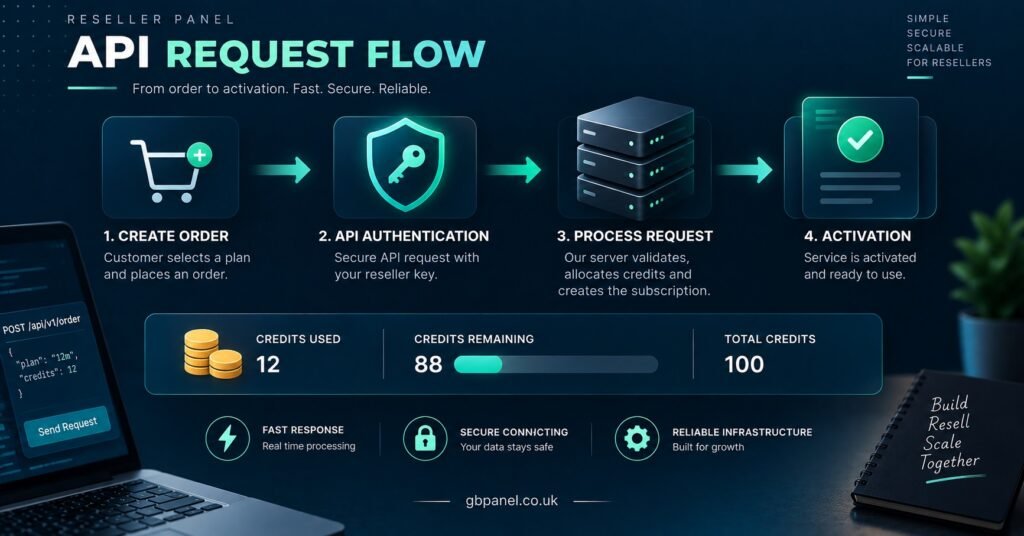
Start with a read-only call. Fetch your credit balance and nothing else. You are confirming that authentication works and that the response format is what you think it is. Note the exact structure that comes back, because that is what your code will depend on.
Create one account on the smallest package available and time it. Record how long the call takes to return and whether credentials arrive in the response itself or have to be fetched separately. A two-call creation flow is workable but needs handling if the second call fails.
Now deliberately break it. Send the same creation request twice with identical details. What you want to learn is whether the panel treats it as one account or two, and whether both attempts cost a credit. If the panel has no protection against duplicates, your integration must provide it, usually by storing your own order reference before the call and refusing to send the same reference twice.
Send a request with a deliberately wrong package or plan value. A well-behaved API returns a clear error and charges nothing. A poorly behaved one returns something ambiguous that your code will happily interpret as success.
Then test the recovery path. Create an account, then call the status lookup for it. Can you reliably find an account you just made using only the information your own system stored? If the answer is no, every future support query will still need a manual dashboard search, and half the benefit is gone.
Finally, run a renewal on that same test account and check the expiry date moves by exactly what you expected. Extensions that stack from today rather than from the existing expiry date will quietly short-change customers who renew early, and you will hear about it.
| Automation goal | What the API must return | What usually goes wrong |
|---|---|---|
| Instant delivery after payment | Account credentials in a single confirmed response | Payment succeeds, panel call fails, customer is charged with nothing to show |
| Automatic renewals | New expiry date after extension | Extension calculated from the current date, cutting the customer’s remaining days |
| Support lookups | Account status by your own stored reference | Only searchable by panel-side ID you never recorded |
| Spend control | Live credit balance before each action | Automation keeps selling after the balance is exhausted |
The Failure Cases That Actually Cost Money
The expensive faults are rarely dramatic. They are timeouts and duplicates.
A timeout is the difficult one because it is genuinely ambiguous. Your request went out, the response never came back, and you do not know whether the account was created. Retrying risks a duplicate. Not retrying risks a paying customer with nothing. The handling is to make your system check before it retries: look the account up by your own reference, and only create if it genuinely does not exist. That is why a reliable status lookup matters more than it first appears.
Credit accounting is the second. Your panel balance and your order records will drift apart, usually slowly. Reconcile them on a schedule, weekly at first, and investigate any gap rather than assuming you miscounted. Since your margin is built directly on what each credit costs you at your current buying tier, an unexplained drift is not an accounting annoyance. It is a margin leak.
The third is key handling. An API key is a credential that can spend your balance. It belongs in server-side configuration, never in front-end code, never in a page a customer can view, and never in a support thread. If a provider asks you to paste your key into a chat to diagnose something, rotate it afterwards.
Pro tip: Log every API call you make with a timestamp, your order reference and the raw response. Storage is cheap. Reconstructing what happened without a log is not.

What to Automate First, and What to Leave Alone
Automate renewals before you automate new sales. Renewals are higher volume over time, lower risk, and involve customers who already exist in your records, so a fault is easier to identify and easier to explain.
Automate status lookups next, because they cut support time without spending a single credit when they go wrong.
Leave account deletion and suspension manual for longer than feels necessary. These are destructive actions, and an automated suspension triggered by a payment provider’s temporary glitch will cut off a paying customer at the worst possible moment. Flag those cases for a human instead.
Be cautious about extending API access downstream. If you are running people beneath you, programmatic access multiplies whatever permissions they already hold, and permission structure is the part of a sub-reseller arrangement that needs settling before access is granted, not after. The same applies if your operation sits behind your own branding, since a white label setup changes what your customers see but not who carries responsibility for the account actions.
Records, Compliance and Machine-Made Actions
An automated system creates a larger number of account actions with no human present at any of them. That makes your logs the only account of what your business did.
Keep them accordingly. For each automated action, you want the date and time, the order or customer reference, the action performed, the response received and the credit effect. This is ordinary business record-keeping, and it is the same material you would want if you ever had to demonstrate how your operation runs.
Worth stating plainly: IPTV is a delivery technology, and an API is simply a way of issuing instructions to a management system. Neither changes anything about content rights. Whether a service is lawful depends on the permissions, licences and arrangements behind the content being delivered, and on the requirements of the territory you operate in. Automation makes an operation faster. It does not make an unlicensed one legitimate, and it leaves a far more detailed trail than manual work ever did.
Common Questions
Does every IPTV reseller panel offer API access?
No. Many panels are dashboard-only, and among those that do expose an API, some restrict it to higher tiers. Confirm it in writing before buying, rather than assuming it is standard.
Can I connect it directly to my website checkout?
Yes, that is the usual reason to want one, but the call must run from your server rather than from the customer’s browser. Anything running in the browser exposes your key to anyone who views the page source.
Do I need a developer?
For a simple flow of payment received, then account created, a competent developer needs a short engagement rather than a long project. What takes the time is not the calls themselves but the error handling around them: duplicates, timeouts and reconciliation.
What happens to my credit if a call fails partway through?
That depends entirely on the panel, which is why it is a question to ask before you commit. Some deduct only on confirmed success, others deduct at the point of request. Test it with a deliberately failing call on a small package and record the result.
Should sub-resellers get their own API key?
Only if their permissions are already defined and you are comfortable with those permissions running at machine speed. Programmatic access does not create new permissions, but it removes the natural slowness that catches mistakes.
Where This Leaves You
An IPTV Reseller Panel API is worth having when your account volume has reached the point where manual creation and renewal are eating hours you would rather spend on customers, and it is worth very little before that. The value sits in renewals and status lookups more than in flashy instant delivery, and the risk sits almost entirely in how failures are handled rather than in the calls themselves.
If you are evaluating one now, do not start with code. Start by getting written answers on documentation, test access and credit behaviour on failed calls, then run the test sequence above on the smallest package available before anything touches a paying customer. If a provider cannot give you clear answers on what happens when a call goes wrong, that is useful information about the integration you would be building on. You can raise these points directly with a UK IPTV reseller panel team before committing to a tier.
API Evaluation Checklist
- Written confirmation of which tier includes API access
- Documentation that exists as a stable page, not a chat message
- Ability to create and rotate keys yourself
- Stated behaviour when a call fails: credit deducted or not
- Duplicate protection, or confirmation that you must provide it
- Status lookup using a reference your own system stores
- Renewal that extends from the existing expiry, not from today
- Credit balance readable before each spending action
- A rate limit figure and a clear response when it is hit
- A named route for support on API issues specifically
- Your own log of every call, response and credit effect
- A weekly reconciliation of panel balance against your order records
[…] an IPTV Reseller Panel Migration around renewal […]