
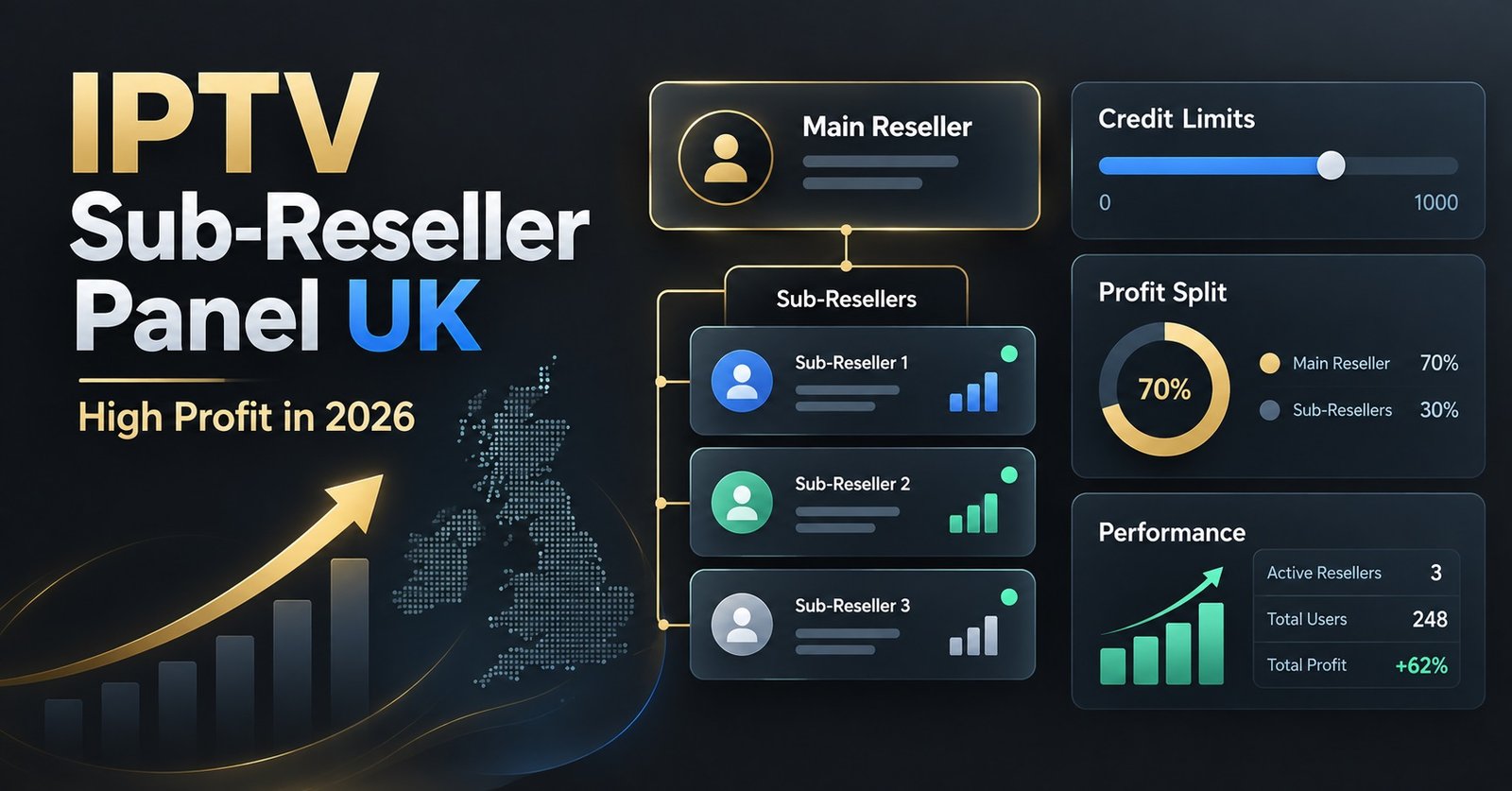
Setting up an IPTV Sub-Reseller Panel UK operation properly means defining permissions, credit limits and a written agreement before you hand any dashboard access to someone else. Skip that groundwork and you end up finding out the hard way, usually through a missing customer, a drained credit balance, or an argument about who actually owns an account.
What an IPTV Sub-Reseller Panel UK Setup Actually Involves
A sub-reseller arrangement means a reseller who already holds a panel account extends limited management access to someone else, who then manages their own slice of customer accounts under the parent reseller’s credit balance. The parent stays accountable to the panel provider. The sub-reseller gets a working dashboard without needing to buy credits directly or hold a provider relationship of their own.
This is different from simply sharing a login. A proper sub-reseller setup gives the second person their own access with boundaries around what they can and can’t touch, while the parent reseller keeps overall visibility and control. Get the boundaries wrong and the structure stops protecting anyone.
The Three Layers of a Sub-Reseller Structure
It helps to think of the relationship in three tiers rather than two. There’s the panel provider, who supplies the infrastructure and sells credits. There’s the parent reseller, who buys those credits and carries the account relationship with the provider. And there’s the sub-reseller, who operates underneath the parent, usually managing their own customer base without ever dealing with the provider directly.
Each layer has a different level of exposure if something goes wrong. The provider is furthest from any individual customer dispute. The parent reseller sits in the middle and absorbs most of the operational risk. The sub-reseller has the least formal standing, which is exactly why the agreement between parent and sub-reseller needs to be specific rather than a verbal understanding built on trust alone.
Deciding What Permissions a Sub-Reseller Should Have
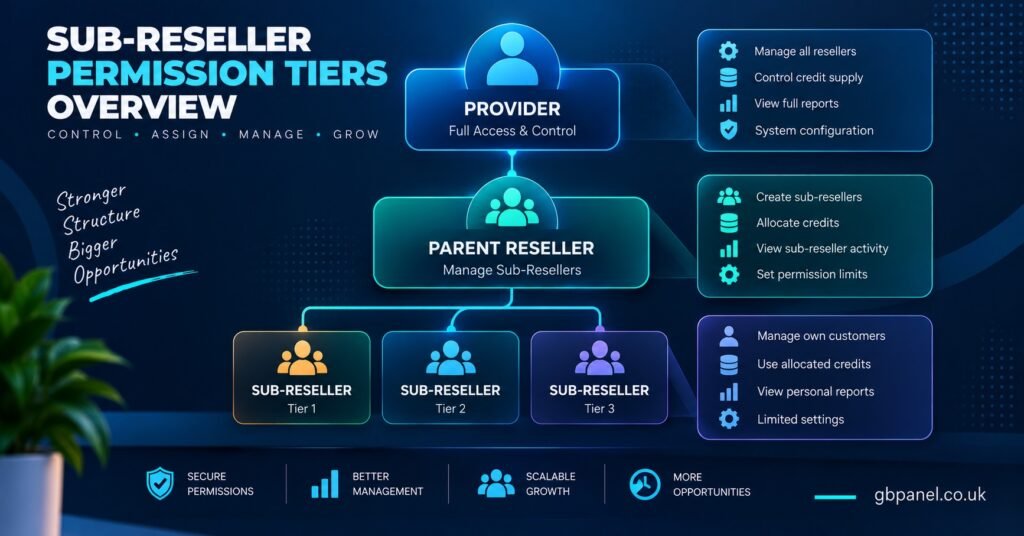
Not every sub-reseller needs the same level of access, and treating a brand new sub-reseller the same as one who has run accounts for two years usually ends badly in one direction or another.
| Permission | Typical for a new sub-reseller | Typical for an established sub-reseller |
|---|---|---|
| Create new customer accounts | Yes, within a set credit allowance | Yes, with a higher or open allowance |
| View full credit balance | Often restricted to their own usage only | Usually visible in full |
| Suspend or reactivate accounts | Limited to accounts they created | Full control over their own book |
| Change customer pricing structure | No | Sometimes, if agreed in writing |
| Request custom packages directly | No, routed through the parent | Sometimes, depending on volume |
Starting a new sub-reseller on the tighter column and loosening restrictions as trust builds is a more sensible approach than opening everything up from day one and hoping it works out.
Setting Up a Sub-Reseller Account Step by Step
The mechanics are usually simpler than the planning around them.
First, confirm your own package includes sub-reseller controls. On GB Panel, this sits at the Growth tier and above, so check your current plan before promising anyone access. See IPTV reseller panel packages if you’re not sure which tier you’re on or need to move up.
Second, decide the credit allowance before you create the sub-reseller login, not after. An open-ended allowance with no cap is how a credit balance disappears in a weekend.
Third, create the sub-reseller account inside the dashboard and set their permission level to match what you agreed on paper, not what feels generous in the moment.
Fourth, run a short test together. Have them create one account, renew one, and check their balance visibility, so any confusion gets caught while it’s still a two-minute fix rather than a live customer problem.
Pro tip: Set the credit allowance about 10 to 15 percent below what you’re comfortable losing in a worst case, not at the exact figure. That buffer gives you room to notice a problem before it becomes a real one.
Building a Sub-Reseller Agreement That Actually Protects You
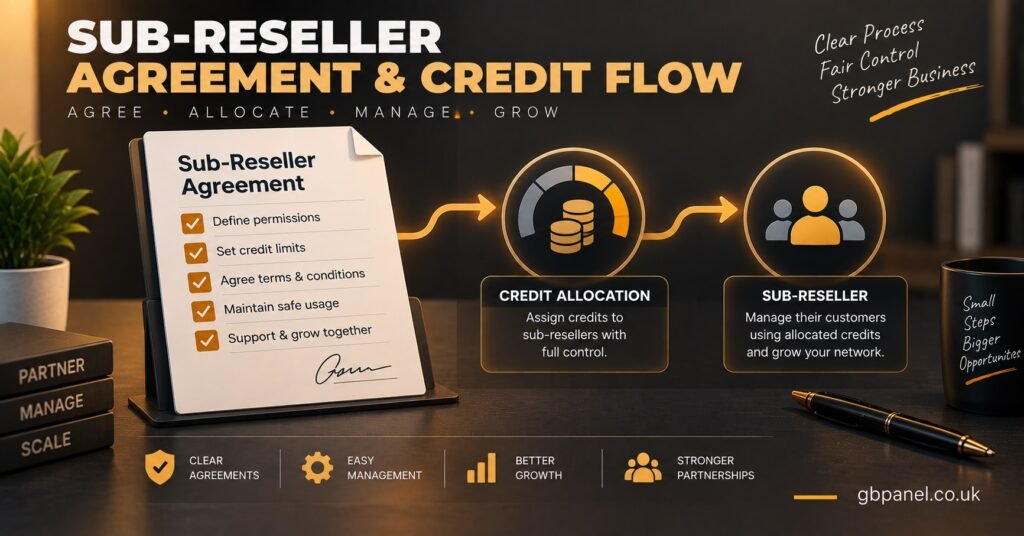
A verbal arrangement is fine right up until something goes wrong, and then it’s worth nothing to either side. A written agreement doesn’t need to be a legal document drafted by a solicitor, but it does need to cover the specific points that cause disputes.
At minimum, the agreement should set out:
- The credit allowance and what happens when it runs low
- Who owns the customer relationship if the sub-reseller stops working with you
- Whether the sub-reseller can set their own retail pricing
- What happens to active customer accounts if the arrangement ends
- How disputes over a specific account get resolved
- Whether the sub-reseller can appoint their own sub-reseller beneath them
- A notice period for either side to end the arrangement
That last point matters more than people expect. Without a notice period, an arrangement can end mid-renewal-cycle with customers caught in the middle and neither side quite sure whose job it was to sort it out.
Margins, Credit Flow and Who Carries the Risk
Credits flow one direction only, from the parent IPTV reseller’s balance to the sub-reseller’s usage. The parent pays the panel provider, the sub-reseller draws down against that balance, and the margin the sub-reseller earns comes from the gap between what they charge their own customers and what the parent charges them internally, if an internal charge exists at all.
Some parent resellers charge their sub-resellers a small markup per credit used. Others simply extend access as a partnership arrangement with no internal charge, relying instead on the sub-reseller bringing in customers the parent wouldn’t otherwise reach. Neither approach is automatically better. It depends on whether you’re treating the sub-reseller as a genuine business partner or as an extension of your own operation.
| Responsibility | Parent reseller | Sub-reseller |
|---|---|---|
| Provider relationship and payment | Holds this directly | No direct relationship |
| Setting the sub-reseller’s credit cap | Sets and adjusts it | Works within it |
| Day-to-day customer support | Usually delegated | Usually handled by them |
| Compliance with UK law and licensing | Ultimately accountable | Shares responsibility for their own customers |
Pro tip: Review the sub-reseller’s account activity monthly, even if the arrangement is running smoothly. A quiet check-in catches drift in behaviour long before it becomes a dispute worth having.
Common Mistakes When Running a Sub-Reseller Panel
The mistakes tend to repeat across different resellers, which is exactly why they’re worth listing plainly.
Handing over full permissions immediately because the sub-reseller is a friend or family member is one of the most common. Trust doesn’t replace a credit cap.
Never documenting who owns which customer is another. When accounts sit in a shared dashboard with no ownership record, working out who’s responsible for a specific customer after a falling out becomes guesswork.
Letting the credit allowance sit unmonitored is a third. A sub-reseller who suddenly creates forty accounts in a week deserves a conversation, not silence until the balance runs dry.
Sub-Reseller Panel Checklist
- Confirm your package tier includes sub-reseller controls
- Set a specific credit allowance before granting access
- Choose a permission level and match it to actual trust, not hope
- Put the agreement in writing, even briefly
- Define account ownership if the arrangement ends
- Agree a notice period for either side
- Set a recurring date to review activity and balance
IPTV Sub-Reseller Panel UK: Frequently Asked Questions
Do I need a separate contract with the panel provider for a sub-reseller?
No. The sub-reseller operates under your existing account and credit balance. Your relationship with the provider doesn’t change; only your internal arrangement with the sub-reseller does.
Can a sub-reseller buy their own credits directly from the provider?
Generally no. Credits are purchased by the parent reseller, and the sub-reseller draws against that allocation rather than holding a separate provider account.
What happens to customer accounts if a sub-reseller stops working with me?
This depends entirely on what your agreement says. Without a written clause covering account ownership, the accounts typically remain under the parent’s overall dashboard, but the practical handover of customer relationships can get messy without a clear plan.
Should every sub-reseller get the same permissions?
No. Matching permission level to how long you’ve worked together and how much you’ve observed of their operation is a more reasonable approach than a flat policy for everyone.
Is a sub-reseller structure worth the extra admin?
For resellers with more demand than they can personally manage, it often is. For a small operation with a handful of customers, the overhead of managing someone else’s access may outweigh the benefit until the customer base grows.
Running an IPTV Sub-Reseller Panel UK setup comes down to defining permissions clearly, capping credit exposure sensibly, and putting the agreement in writing before access is granted rather than after a problem shows up. Start with tighter permissions than feel necessary, loosen them as the relationship proves itself, and review activity regularly rather than assuming a smooth start means a smooth year. If you’re weighing whether your current package supports this properly, the IPTV reseller cost per credit breakdown and the white label IPTV reseller panel setup guide are worth reading alongside this one before you extend access to anyone.
[…] IPTV Panel Resellers running any real volume tend to reach a point where handling every single customer themselves stops making sense. That’s usually when sub-reseller arrangements start looking attractive, not because the reseller wants to give away control, but because delegating part of the customer base to someone else frees up time for growing the business rather than manually creating every account. […]