Book Appointment Now
Starting an IPTV Reseller Business in the UK 2026
Most people who want to Starting an IPTV Reseller Business in the UK are looking for one thing: a clear route from “I’m interested” to actually taking on paying customers. That route runs through four practical decisions rather than any single secret step. You need to understand what compliance actually asks of you, pick a IPTV reseller panel that won’t slow you down once you have real customers, work out how credits and pricing fit together, and know what a sub-reseller structure looks like once you outgrow doing everything yourself.
What “Starting an IPTV Reseller Business in the UK” Actually Involves
Reselling in this space means buying access in bulk from a panel provider, then creating and managing individual customer accounts under your own brand and pricing. You are not building the underlying infrastructure or producing content. You’re running the customer-facing side of the business: onboarding, renewals, support and pricing, while the panel handles the technical account management on the back end.
That distinction matters because it shapes where your time actually goes. New resellers often expect the hard part to be technical setup. In practice, the hard part is usually the ongoing admin: chasing renewals, answering the same support questions, and keeping track of who’s active and who’s about to lapse. A decent panel solves most of that for you. A weak one leaves you doing it manually in a spreadsheet, which is where a lot of new resellers quietly burn out within the first few months.
The Realistic Route In
There’s a sequence that tends to work better than jumping straight to buying credits.
Start by getting honest about scale. Someone planning to serve fifteen friends and family members has a very different setup to someone planning fifty or a hundred paying customers within the first year. That number affects which credit tier makes sense, whether sub-reseller access is worth having from day one, and how much time you should budget for support.
Next, sort out the business side before the technical side. That means deciding whether you’re operating as a sole trader or through a limited company, understanding your basic tax obligations, and being clear on what you’re actually allowed to distribute and to whom. This is the part people skip because it’s less exciting than picking a panel, and it’s exactly the part that causes problems later.
Once that’s settled, choose a panel and buy an appropriately sized credit package. Then set your retail pricing, which is entirely your decision as the reseller, not something the panel dictates.
Pro tip: Price your first month or two slightly conservatively. It’s far easier to raise prices once you have a track record than to explain a sudden increase to your earliest customers.
What You Need Before You Start
A few things genuinely need to be in place before you take on your first customer, rather than sorted out reactively.
You need a way to accept payment that you can actually reconcile against customer accounts, because manual payment tracking becomes unmanageable past a handful of customers. You need a support channel that customers can reach you through, whether that’s WhatsApp, email or something more structured, and a rough idea of your own response times. You also need a working understanding of what compliant reselling looks like in your specific case, because “the panel is professional and takes payment” is not the same thing as being compliant.
None of this needs to be elaborate at the start. It needs to exist and be consistent.
Choosing a Reseller Panel That Won’t Slow You Down
This is where the business either runs smoothly or turns into constant admin. The panel is the tool you’ll be in daily, so its quality has a direct effect on how much of your time reselling actually takes.
| Decision factor | What to look for | Why it matters |
|---|---|---|
| Credit visibility | Balance shown at all times, not just after a top-up request | Stops you accidentally overselling what you can deliver |
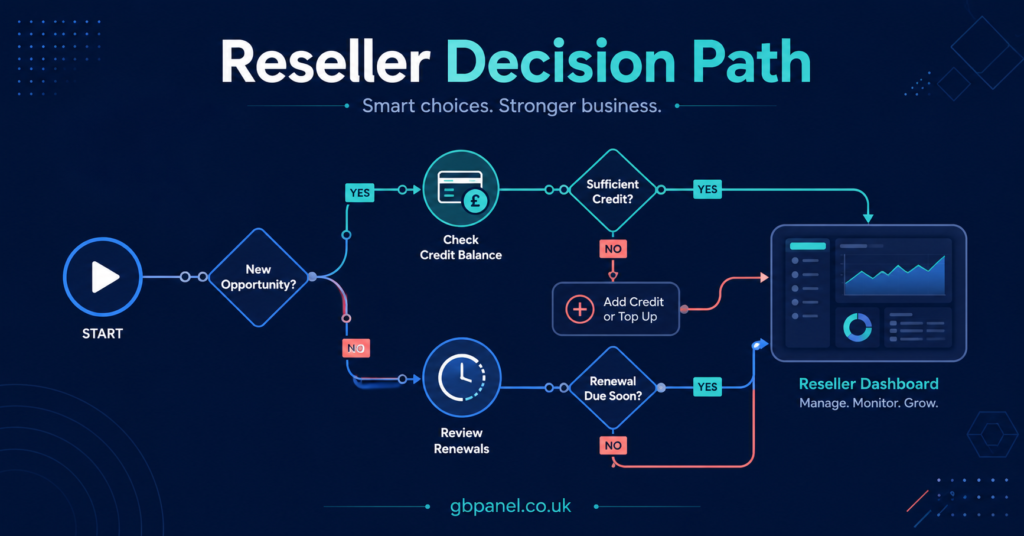
| Renewal alerts | Automatic flags before an account lapses | Renewals are where most reseller income actually comes from |
| Sub-reseller controls | Optional, tiered access rather than all-or-nothing | Lets you grow without handing over your whole account |
| Support responsiveness | Direct answers, ideally with a UK-based team | You’re the one your customers call when something breaks |
A UK reseller dashboard built around credits and renewal tracking is worth comparing against whatever else you’re considering, specifically on those four points rather than on how polished the sales page looks.
How Credits and Pricing Actually Work
Credits are the wholesale unit you buy in bulk, then spend one at a time creating or renewing a customer account. What you charge each customer is entirely your decision. A panel provider sets the wholesale rate; it does not, and shouldn’t, dictate your retail pricing.
The mistake new resellers make here is buying a large credit package before they know their actual customer volume. Credits sitting unused don’t earn anything back. It’s more sensible to start with a smaller starter credit package and step up once you know roughly how many customers you can realistically onboard and retain each month.
Pro tip: Track your renewal rate from month one, even informally. A reseller with thirty customers and an 80 percent renewal rate is in a stronger position than one with sixty customers and a 40 percent renewal rate, because the first is a business and the second is a series of one-off sales.
Common Mistakes New UK Resellers Make
A handful of patterns show up repeatedly in the first few months.
Underpricing to win customers quickly, then struggling to raise prices later without losing them, is one of the most common. Another is treating support as an afterthought, which works fine with five customers and falls apart at fifty. Buying credits in bulk before establishing demand ties up money that could otherwise fund marketing or a better support setup. And skipping the compliance groundwork entirely, on the assumption that a professional-looking panel and a payment processor are proof enough of legitimacy, is the one that causes the most serious problems down the line.
Scaling Into a Sub-Reseller Network
Once you have a stable customer base, some resellers extend limited management access to trusted sub-resellers rather than handling every new customer themselves. This works well when the sub-reseller relationship is clearly defined from the start: who owns the customer relationship, who handles support escalations, and what margin the sub-reseller actually earns.
It works badly when those boundaries are assumed rather than agreed. A sub-reseller who believes they own a customer relationship that you consider yours is a dispute waiting to happen. If you’re considering this route, put the terms in writing before extending access, even informally over email.
Frequently Asked Questions
Do I need to register a business to become an IPTV reseller in the UK?
It’s strongly advisable. Operating as a sole trader or limited company gives you a clear tax position and a proper footing for contracts, payment processing and any disputes that arise with customers or your panel provider.
How much does it cost to start?
Costs vary by panel provider and credit tier, and depend on how many customer accounts you plan to manage at launch. Starting with a smaller credit package and scaling up as demand grows is generally more sensible than committing to a large tier before you have customers.
Can I set my own prices as a reseller?
Yes. The panel provider sets the wholesale credit cost. What you charge your own customers, including any bundles or discounts, is your decision entirely.
What am I responsible for as a reseller?
You’re responsible for ensuring your marketing, pricing and customer activity comply with applicable UK laws, licensing requirements and intellectual property obligations. This sits with you as the reseller, not with the panel provider.
Do I need technical skills to run a panel?
Not in depth. A well-designed dashboard handles account creation, renewals and status tracking without requiring server or software knowledge. What helps more is organisation and consistent customer communication.
Should I offer sub-reseller access straight away?
Usually not immediately. It tends to make more sense once you have a stable customer base and a clear view of your own margins, so you know what’s realistic to offer a sub-reseller without cutting into your own income.
Where This Leaves You
Deciding to become an IPTV Panel reseller in the UK is the easy part. What actually determines whether it becomes a proper business is whether you sort out compliance and business basics early, choose a panel that keeps renewals and credits visible rather than buried in messages, and price conservatively enough at the start that you can adjust later without upsetting your first customers. Get those three things right and the rest, including support and any future sub-reseller structure, tends to fall into place around them. If you’re still comparing panels, look at how each one handles renewal visibility and credit tracking before anything else, since that’s where most of your ongoing time will actually go.
New UK Reseller Checklist
- Confirm your business structure (sole trader or limited company) before taking payments
- Understand your compliance obligations for marketing and distribution in the UK
- Choose a panel based on renewal alerts and credit visibility, not just price
- Start with a smaller credit package matched to realistic early demand
- Set retail pricing with room to hold or lower it later, not just raise it
- Set up a consistent support channel before your first customer signs up
- Track renewal rate from month one, not just total sign-ups
- Put any sub-reseller terms in writing before extending access