
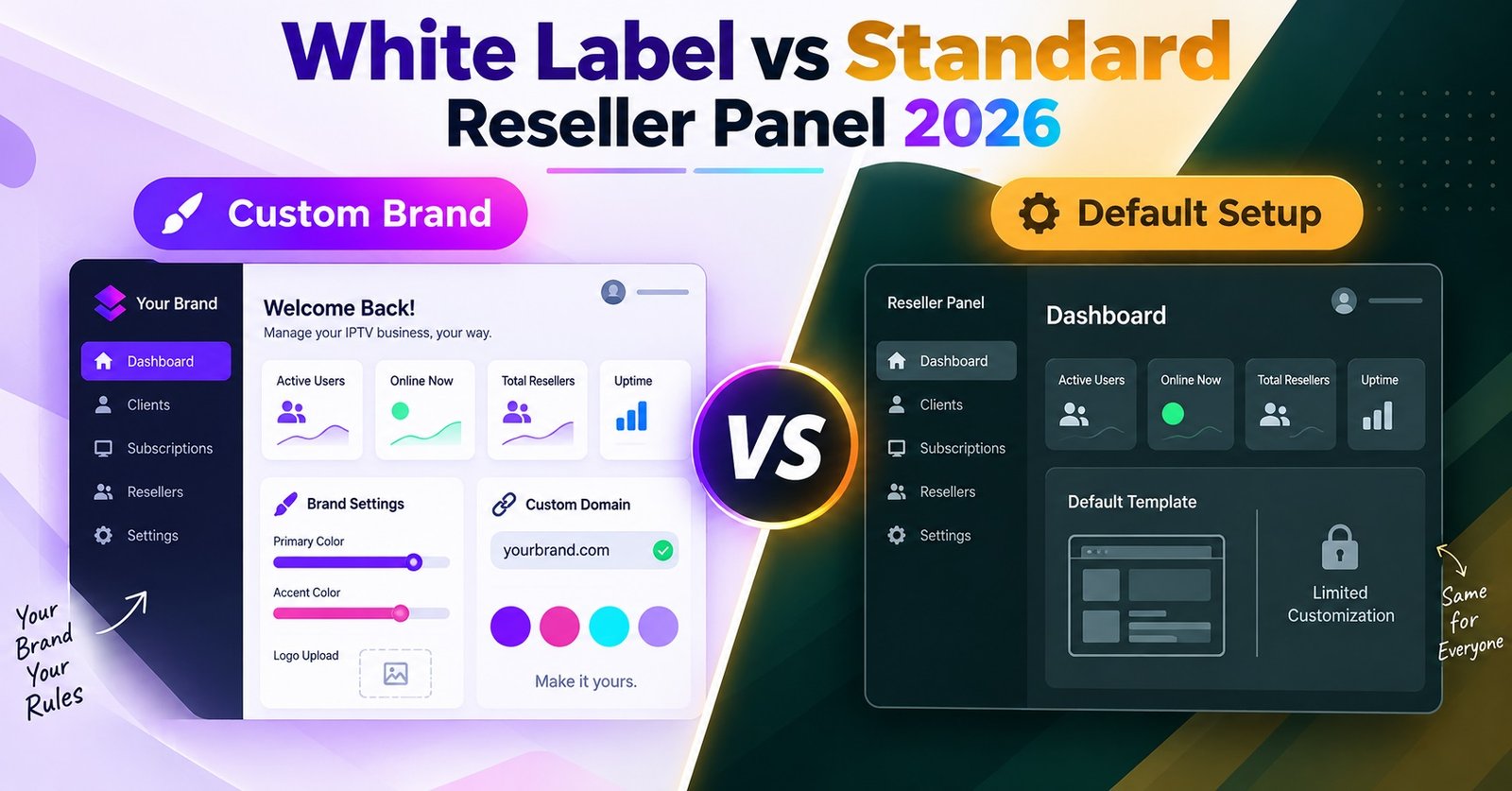
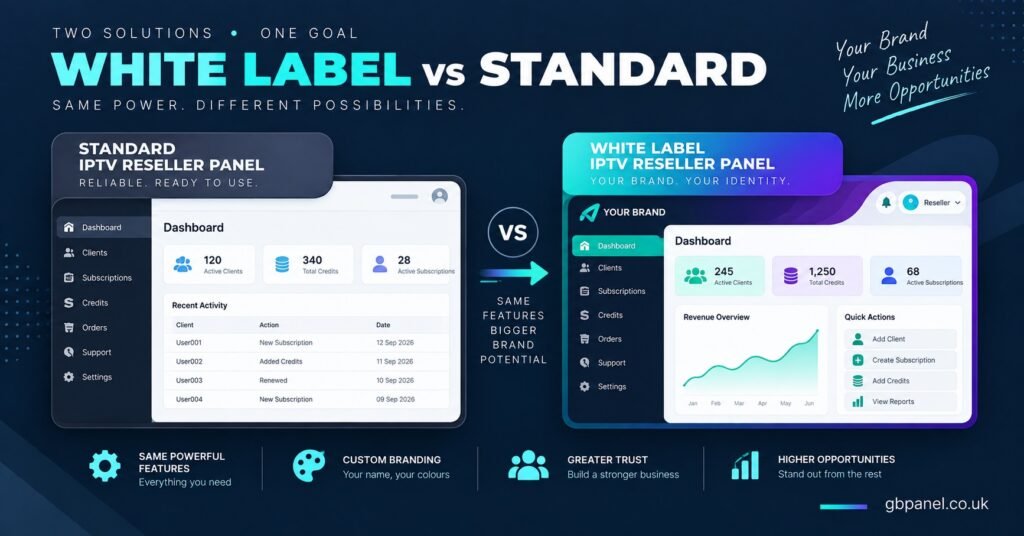
White Label vs Standard IPTV Reseller Panel comes down to one question: do your customers see your brand, or do they see the software provider’s? A standard panel gives you a working dashboard with someone else’s name on every customer-facing screen. A white label panel dresses that same dashboard in your business identity instead. The account management underneath, credits, renewals, customer records, works the same either way. What differs is who your customer thinks they’re actually paying.
Standard Panel or White Label: The Direct Comparison
Before weighing costs or use cases, it helps to see the two side by side.
| Feature | Standard Panel | White Label Panel |
|---|---|---|
| Customer-facing branding | Provider’s name and app | Your business name and app |
| Setup speed | Immediate, no configuration | Slower, branding assets required |
| Typical cost | Included in credit price | Often an added fee or higher tier |
| Best suited to | New resellers testing the market | Established resellers building a brand |
That table oversimplifies things slightly, because “white label” itself varies between providers, but it’s a fair starting point for anyone comparing the two options for the first time.
What Actually Stays The Same Underneath
This is the part buyers often get wrong. Choosing a white label option does not usually mean better streaming quality, faster servers, or more reliable uptime. The infrastructure delivering content to a subscriber’s device is typically identical between a provider’s standard and white label tiers. Credits still deduct the same way. Accounts still expire on the same schedule. Renewal tracking still works the same in the dashboard.
What changes sits entirely on the surface: app name, logo, splash screen, and sometimes a dedicated login domain. A reseller who assumes white label buys them technical superiority is paying for the wrong thing.
Three Questions That Actually Decide Which One You Need
Rather than asking “which is better,” ask these three questions about your own operation.
Do your customers currently know they’re buying through a third-party app? If they’ve never questioned it, a standard panel may be doing its job fine. If you’re fielding questions about a generic app icon, that’s a signal branding matters to your customer base.
Are you planning to grow past a handful of regular customers? A standard panel is usually cheaper and faster to start with, which suits testing a market before committing. Once volume grows, the cost of a white label tier becomes easier to justify against the retention it protects.
Would a competitor recognise your customers as reachable through the same visible software? Two IPTV panel resellers using an identical unbranded app are effectively advertising to each other’s customers. That risk disappears once the interface carries your own name.
Pro tip: If you’re unsure which category you fall into, ask new customers directly how they found you and whether they compared prices elsewhere first. Their answer tells you more about branding value than any sales page will.
Where The Cost Difference Actually Comes From
A standard panel’s price is straightforward: you pay for credits, and the dashboard access comes with it. A white label tier adds cost somewhere, whether that’s a one-off setup fee, a higher credit-tier requirement, or a small recurring charge for hosting your branded app and domain. None of these models is automatically the worse deal, but they need to be compared properly rather than assumed. Working out your IPTV reseller profit margin before adding a branding fee on top gives you a realistic picture of whether the upgrade pays for itself in retained customers.
Mistakes Resellers Make When Choosing Between The Two
Picking white label purely because it sounds more professional, without checking what’s actually included, is the most common one. Some providers rebrand only the app icon while leaving login errors and expired-account notices showing their own name, which defeats much of the point.
Staying on a standard panel indefinitely out of habit is the opposite mistake. Resellers who’ve built a genuine customer base sometimes delay the branding upgrade for years, not because it isn’t worth it, but because switching feels like unnecessary admin. That hesitation usually costs more in customer confusion than the upgrade itself would.
Comparing a bundled white label price against an unbundled standard price is the third common error. Always ask for the branding fee broken out separately so you’re comparing like for like.
If Sub-Resellers Are Part Of Your Operation
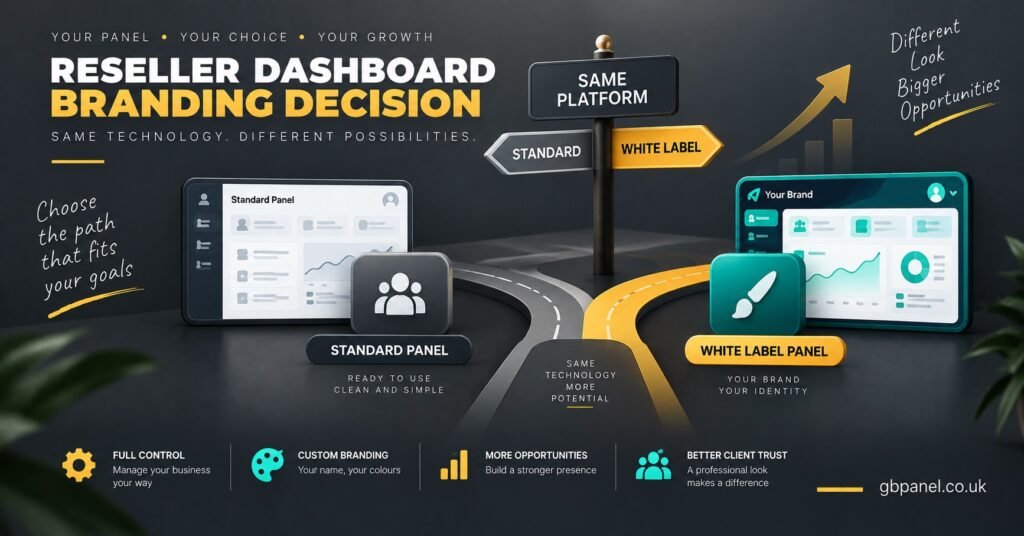
A sub-reseller panel sitting underneath a white label setup usually inherits your branding rather than the original provider’s, which keeps your own supply chain invisible to end customers. On a standard panel, that layer is less consistent: some providers show the top-level brand no matter how many resellers sit in between. If you’re planning to extend access to sub-resellers, confirm which model your provider actually follows before assuming either one behaves the way you expect.
Pro tip: Ask to see the sub-reseller’s view of the dashboard during a demo, not just your own. Branding inconsistencies often show up one layer down before they show up at the top.
Frequently Asked Questions
Does a white label panel perform better than a standard one?
No. Performance depends on the underlying infrastructure, which is typically shared between a provider’s standard and white label tiers. Branding does not change streaming quality or server reliability.
Can I switch from standard to white label later?
Usually yes, though timing varies by provider. Ask specifically whether existing customer accounts carry over automatically or need to be recreated under the new branding.
Is white label worth it for a small reseller just starting out?
Not always immediately. Many UK IPTV panel resellers start on a standard panel to test their market, then move to white label once customer volume justifies the added cost.
Do standard panels look unprofessional to customers?
Not inherently. Plenty of resellers run successful operations on standard panels. Branding matters more once you’re competing directly with other resellers using the same visible software.
What should I ask a provider before choosing either option?
Ask exactly what’s included in each tier, whether the fee structure is one-off or recurring, and what happens to your setup if you decide to change tiers later.
Choosing between White Label vs Standard IPTV Reseller Panel setups isn’t about picking the objectively better option, because neither one is universally correct. It’s about matching the choice to where your operation actually sits right now. A standard panel suits testing a market or running a small, steady customer base without extra overhead. A white label upgrade earns its cost once branding starts affecting how customers perceive and trust your business. Work out your current customer volume and how much a generic app icon is actually costing you in trust, then decide from there rather than defaulting to whichever option sounds more impressive.
Decision Checklist
- Count how many customers have questioned or compared your current app or branding
- Get the white label fee quoted separately from the standard credit price
- Confirm whether performance genuinely differs between tiers with your specific provider
- Check what happens to customer accounts if you switch tiers later
- Ask how sub-reseller branding is handled under each option
- Revisit the decision once your customer base doubles from where it is today
One thing worth flagging: gbpanel.co.uk already has a live “Premium White Label IPTV Reseller Panel UK Setup Guide” (published 10 September) and an “IPTV Reseller Vs Sub Reseller” piece. This article is written as a comparison/decision piece rather than a setup guide, with a different structure and FAQ set, so it shouldn’t cannibalise either, but you may want to add internal links between all three once this one is live.
[…] IPTV reseller panels take one of two routes for mobile use, and each comes with trade-offs worth knowing before you pick […]