
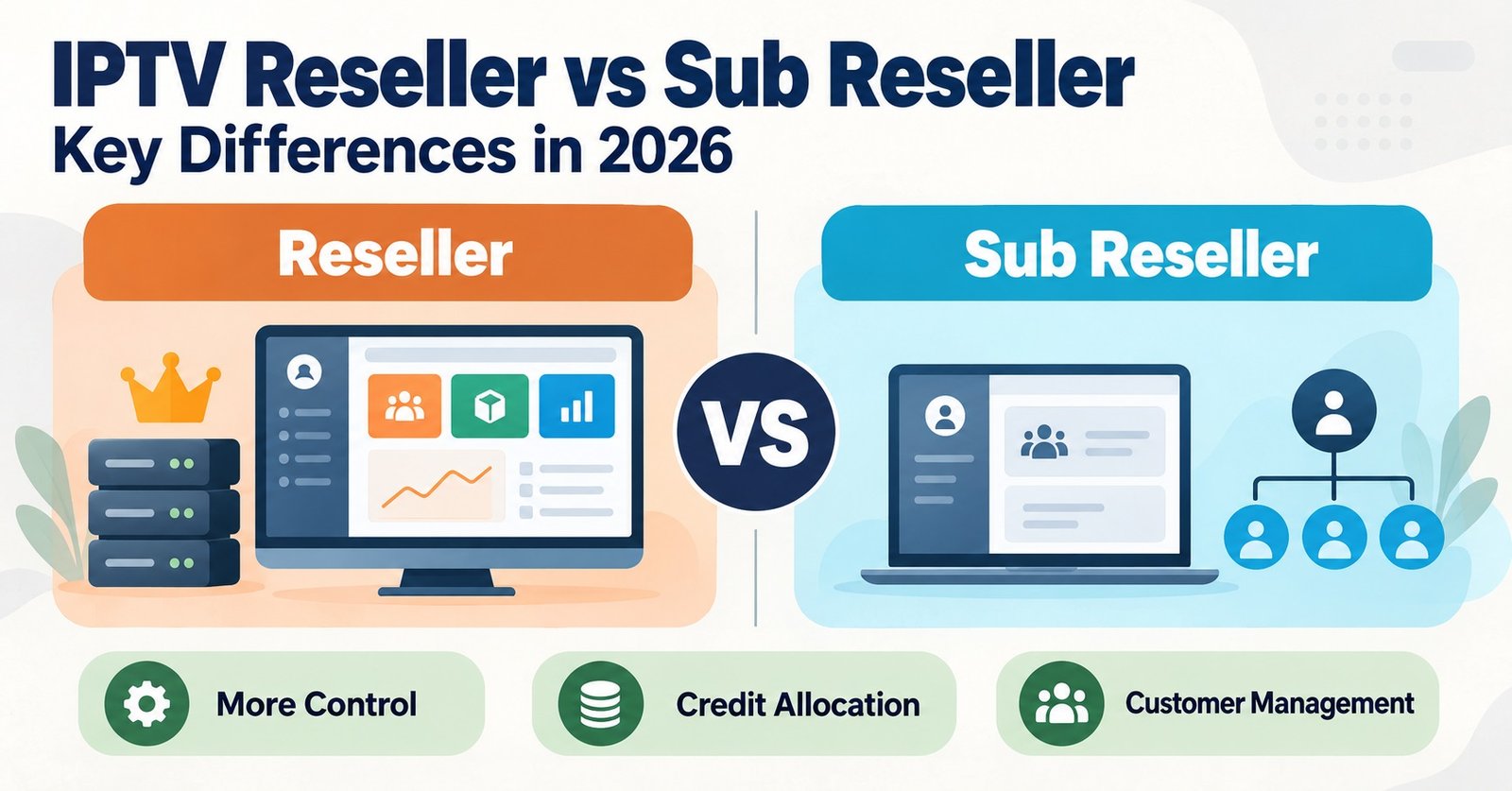
IPTV Reseller vs Sub Reseller comes down to one thing: who holds the direct account with the panel provider, and who is working underneath someone else’s allocation. A IPTV Panel reseller buys credits or packages directly from the panel and answers to the provider. A sub-reseller gets access, credits, or permissions handed down from a reseller, and answers to that reseller instead. Everything else, the pricing, the support responsibility, the risk if something goes wrong, follows from that one structural difference.
IPTV Reseller vs Sub Reseller: The Core Difference
A reseller has a direct commercial relationship with the panel provider. They buy credits or a package tier, they get their own dashboard login, and any terms, pricing changes, or support escalations go straight between them and the provider. Nobody sits between the reseller and the source.
A sub-reseller doesn’t have that direct line. Someone else, the reseller, has agreed to extend part of their own access downward. The sub-reseller might get their own limited login, or they might just send requests to the reseller who actions them. Either way, the sub-reseller’s credits, pricing, and support all pass through the reseller first. If the reseller’s account gets suspended, the sub-reseller’s customers are affected too, even though the sub-reseller did nothing wrong.
This is not a difference in skill or seriousness. Plenty of sub-resellers run tighter operations than the resellers above them. It’s purely a question of where each party sits in the chain, and how much control that position gives them.
Where Each Role Actually Sits in the Chain
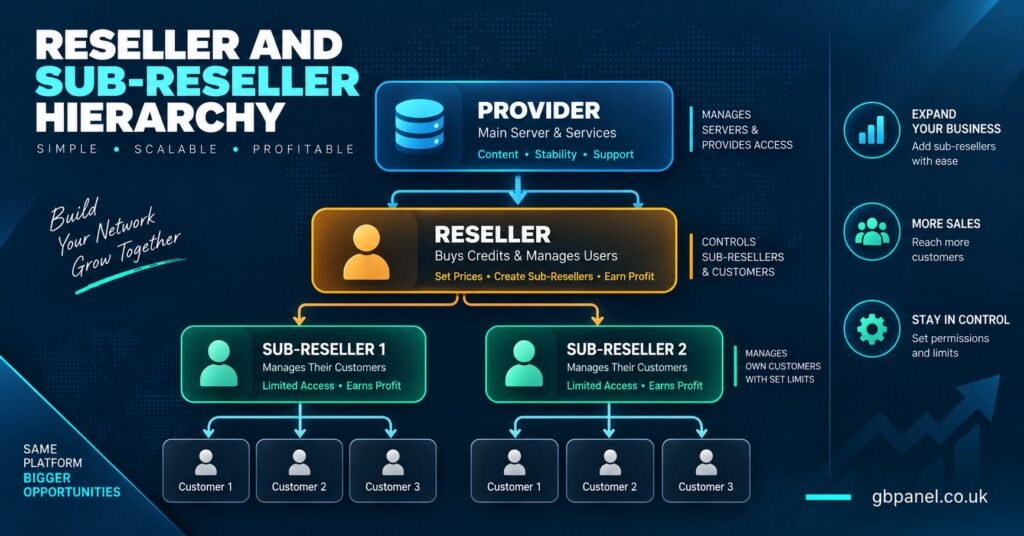
Picture three layers. The panel provider sits at the top, running the infrastructure and issuing credits. The reseller sits in the middle, buying those credits in bulk and deciding how to distribute them. The sub-reseller sits below the reseller, working with whatever slice of access has been agreed.
| Layer | Who they answer to | What they control |
|---|---|---|
| Panel provider | Nobody above them commercially | Infrastructure, credit issuance, platform rules |
| Reseller | The panel provider | Credit purchasing, pricing to their own customers, sub-reseller permissions |
| Sub-reseller | The reseller | Their own customer accounts, within limits the reseller sets |
A sub-reseller is never a customer of the panel provider directly. Even if the provider’s dashboard technically shows sub-reseller logins, the commercial relationship, the invoice, the support obligation, sits with the reseller. That’s worth understanding before anyone signs anything, because it shapes what a sub-reseller can and can’t demand.
What a Reseller Actually Controls
A reseller who buys directly from a panel decides their own retail pricing, sets their own package structure, and typically gets first access to any new features or tier upgrades. They also carry the full weight of the provider relationship. If credits run low, if a renewal fails, if the provider changes terms, the reseller deals with it directly.
IPTV Panel Resellers running any real volume tend to reach a point where handling every single customer themselves stops making sense. That’s usually when sub-reseller arrangements start looking attractive, not because the reseller wants to give away control, but because delegating part of the customer base to someone else frees up time for growing the business rather than manually creating every account.
What a Sub-Reseller Actually Controls
A sub-reseller’s control depends entirely on what the reseller above them has agreed to extend. Some reseller setups give sub-resellers a genuinely functional dashboard, letting them create and renew their own customer accounts within an allocated credit pool. Others keep things tighter, with the sub-reseller sending requests and the reseller actioning them manually.
Neither approach is wrong. A reseller managing several sub-resellers across different regions might prefer the looser, dashboard-based model because it scales better. A reseller who’s only just started extending access to one trusted contact might prefer the manual model until trust is established.
What a sub-reseller should never assume is that their access is permanent or contractually guaranteed by the panel provider itself. It isn’t. It exists at the discretion of the reseller, and it can be adjusted or withdrawn by that reseller according to whatever agreement the two of them have made.
Pro tip: if you’re considering becoming a sub-reseller, ask upfront exactly what happens to your existing customer accounts if the arrangement ends. Get the answer in writing before you commit any customers to the setup.
Setting Up a Sub-Reseller Arrangement Step by Step
- The reseller decides how much of their credit allocation and dashboard access they’re willing to extend.
- Both sides agree pricing, meaning what the sub-reseller pays the reseller per account, separate from what the sub-reseller charges their own customers.
- The reseller either creates a limited sub-account within the panel dashboard, if the platform supports it, or sets up a manual request process.
- Both sides agree what happens on renewal, on non-payment, and if either party wants to end the arrangement.
- The sub-reseller starts creating or requesting customer accounts within the agreed limits, and both sides track usage against whatever reporting method they’ve chosen.
The step that gets skipped most often is the third and fourth together. People agree pricing and jump straight into working, without ever writing down what happens if the sub-reseller stops paying, or if the reseller decides to reduce access. That gap causes almost every dispute that comes up later.
Sub-Reseller Agreement: What It Should Actually Cover
A written agreement doesn’t need to be a formal legal contract to be useful. Even a simple document both sides sign protects everyone involved. At minimum, it should cover:
- How many credits or accounts are being allocated, and how that can change over time
- The price the sub-reseller pays the reseller per account or per credit
- Who handles customer-facing support, and what happens when a customer complaint escalates
- What happens to active customer accounts if the arrangement ends
- Notice period required from either side before ending the arrangement
- Whether the sub-reseller can rebrand the service under their own name, or must disclose the reseller’s involvement
- What happens if the reseller’s own upstream account is suspended or terminated
A simple template might read: “This agreement covers the allocation of [number] credits per [period] from [reseller name] to [sub-reseller name], at a rate of [agreed price] per account. The sub-reseller is responsible for their own customer support and pricing. Either party may end this arrangement with [agreed notice period] written notice. On termination, active customer accounts will be [handled according to whatever both sides agree, for example transferred, honoured until expiry, or closed].”
Fill in the brackets to match the actual arrangement. The point isn’t the wording, it’s making sure both sides have actually discussed and agreed these points before money and customers are involved.
Where the Roles Get Blurred, and What Goes Wrong
The most common problem isn’t dishonesty, it’s ambiguity. A reseller tells a sub-reseller “just use my login for now” without setting limits, and six months later neither side can say how many accounts were actually created against which allocation. When the numbers stop matching, trust breaks down fast.
Another recurring issue is sub-resellers assuming they have a relationship with the panel provider that doesn’t exist. If a sub-reseller contacts the provider directly asking for support, most providers will redirect them back to the reseller, because the provider’s contract is with the reseller, not the sub-reseller. That can feel unhelpful when a customer is waiting on a fix, but it’s a direct consequence of how the chain is structured.
A third pattern shows up when a reseller extends sub-reseller access without thinking through succession. If the reseller stops trading, retires, or loses their own panel access, every sub-reseller underneath them is exposed, often without warning. Anyone taking on a sub-reseller arrangement should ask how established and stable the reseller above them actually is, not just how good their pricing looks.
IPTV Reseller vs Sub Reseller: Which One Should You Choose
If you want direct control over pricing, terms, and your own relationship with the panel provider, and you’re prepared to manage that relationship yourself, becoming a reseller is the more independent route. It usually means a larger upfront commitment, since you’re buying credits directly rather than working through someone else’s allocation.
If you’re starting smaller, testing whether IPTV reselling suits you, or you already have a trusted contact who’s an established reseller, working as a sub-reseller lowers the barrier to entry considerably. You get to build a customer base without the full commercial weight of a direct provider relationship, in exchange for less control and more dependency on the reseller above you.
Neither option is permanently fixed. Plenty of sub-resellers become full resellers once their customer base and confidence grow. The starting point matters less than understanding clearly which position you’re actually in right now.

Before locking in either role, it’s worth working out what the numbers actually look like month to month. GB Panel’s IPTV reseller profit calculator is a useful way to see how margins hold up once you account for what you’re paying per credit, which matters differently depending on whether you’re buying direct as a reseller or paying a marked-up rate as a sub-reseller. If you’re weighing up how IPTV reseller panel cost per credit scales at different volumes, that’s also worth reading before agreeing a sub-reseller rate, since it shows you roughly what the reseller above you is likely paying upstream.
Sub-resellers thinking about running their service under their own brand, rather than visibly operating under someone else’s name, should also look at what a white label IPTV reseller panel setup actually involves, since branding rights are one of the details that often gets left out of informal sub-reseller agreements entirely.
Reseller vs Sub-Reseller Checklist
- Confirm in writing whether you’re being offered a reseller or sub-reseller position, not just told verbally
- Get the credit allocation, pricing, and renewal terms documented before creating any customer accounts
- Ask what happens to existing customers if the arrangement ends or changes
- Check whether rebranding or white labelling is permitted under the arrangement
- Establish who handles customer support directly, and what the escalation path looks like
- Ask how long the reseller above you has been operating, if you’re considering a sub-reseller role
- Keep your own record of accounts created and credits used, separate from whatever the other side reports
Frequently Asked Questions
Can a sub-reseller become a full reseller later?
Yes. There’s nothing stopping a sub-reseller from building enough volume and confidence to buy directly from a panel provider as an independent reseller. The transition just needs planning around existing customer accounts and any notice period owed to the current reseller.
Does a sub-reseller get their own dashboard login?
It depends on the panel and the arrangement. Some providers support genuine sub-accounts with limited permissions, while other sub-reseller setups run entirely through the reseller manually actioning requests.
Who is responsible if a sub-reseller’s customer has a problem?
Usually the sub-reseller handles first-line support, since they hold the direct relationship with that customer. If the issue is a platform-level fault rather than something account-specific, it typically needs escalating up through the reseller rather than the sub-reseller contacting the provider directly.
Is a sub-reseller arrangement riskier than being a direct reseller?
It carries a different kind of risk. A sub-reseller depends on the reseller above them staying operational and honest, which is outside their direct control. A reseller carries more financial exposure but has more control over the outcome.
Do sub-resellers usually pay more per account than resellers?
Generally yes, since the reseller above them is adding a margin on top of what they paid the panel provider. How much more varies by arrangement and isn’t something a provider sets or regulates.
IPTV Reseller vs Sub Reseller is ultimately a question of where you sit in the chain and how much of that position you’re comfortable with. A IPTV Panel reseller carries direct responsibility and direct control. A sub-reseller trades some of that control for a lower barrier to entry, provided the arrangement above them is documented properly and the reseller they’re working with is stable. Whichever side you’re on, get the terms written down before any customer accounts are created, not after something goes wrong.
[…] a competitor recognise your customers as reachable through the same visible software? Two IPTV panel resellers using an identical unbranded app are effectively advertising to each other’s customers. That […]