
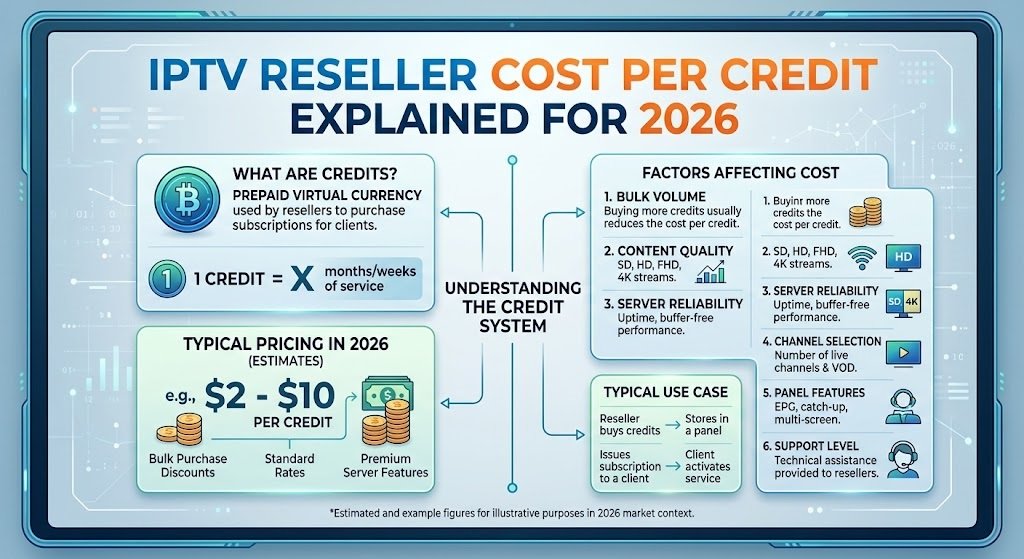
IPTV reseller cost per credit is not a single fixed number. It moves depending on how many credits you buy in one go, and understanding that scale is the first thing any reseller needs to work out before committing money to a panel. Buy a small batch and you pay a higher rate per credit. Buy in bulk and the rate drops, sometimes significantly. Getting this wrong, either by overpaying for a small volume or overcommitting to a large one you don’t need yet, is one of the quickest ways a new UK IPTV panel reseller ends up with a poor margin before they’ve even signed their first customer.
IPTV Reseller Cost Per Credit
Most UK panels price credits in bands rather than a flat per-unit rate. A typical structure looks like this:
| Credit Volume | Price Per Credit |
|---|---|
| Below 120 credits | £2.20 |
| 121 to 300 credits | £2.00 |
| Above 300 credits | £1.80 |
The pattern is consistent across most providers even when the exact figures differ. Smaller batches cost more per credit because the provider is taking on more administrative overhead relative to the volume, and because smaller resellers are typically still proving out their customer base. Once you’re buying in the hundreds, the provider is dealing with one transaction instead of several, and that efficiency gets reflected in the rate.
It’s worth being clear about what a credit actually buys. In most reseller setups, one credit equals one month of access on a single customer account. So the cost per credit is effectively your wholesale cost per customer per month, before you decide what to charge on top.
Why the Rate Drops as Volume Increases
The tiered structure isn’t arbitrary. Panels run on infrastructure costs that don’t scale in a straight line with the number of resellers buying small amounts. A provider processing one 400-credit purchase spends far less time and admin per credit than processing eight separate 50-credit purchases from eight different resellers. That saving gets passed down, at least partly, through the lower per-credit rate at higher tiers.
There’s also a retention incentive built into most tiered models. A reseller who commits to 300 credits has effectively signalled they’re running a real operation rather than testing the water, and providers generally want to reward that with better terms because a committed reseller is a more predictable source of repeat business than someone buying in small, irregular batches.
None of this means jumping straight to the top tier is automatically the right move. If you don’t have the customer base to use 300 credits within a reasonable window, you’re just tying up cash in unused stock.
Pro tip: Before buying a bulk tier, check how long your credits stay valid. A lower per-credit rate is worthless if the batch expires before you’ve used half of it.
Working Out Your Real Margin Per Account
The cost per credit only tells you half the story. What actually matters to your business is the gap between what you pay per credit and what you charge your own customer for that same account.
Say you’re buying in the 121 to 300 band at £2.00 per credit, and one credit covers one month of access for a customer. Your wholesale cost for that customer is £2.00 a month. Whatever you retail that account for, minus your own operating costs (support time, payment processing, any marketing spend), is your actual margin. A reseller charging a modest monthly rate on volume can still do well if the per-credit cost is low enough and renewals are consistent. A reseller charging more per customer but buying in small, expensive batches might find the margin thinner than it first looks.
This is why the headline “cost per credit” figure matters less in isolation than it does next to your renewal rate. A low per-credit cost with poor renewal discipline, where accounts lapse and don’t get renewed, still loses you money. A slightly higher per-credit cost with strong renewal habits and low churn will usually outperform it over a full year.
Which Tier Should a New Reseller Buy?
There’s no single correct answer, but a few practical questions help narrow it down:
- How many active customers do you realistically expect to have within the first two to three months? Don’t buy for a customer base you’re hoping for; buy for the one you’re likely to have.
- Can you commit to using credits before any expiry window closes? A bulk discount you can’t use in time isn’t a discount at all.
- Is your cash flow comfortable enough to front the cost of a larger batch, or does a smaller tier keep things safer while you build momentum?
- Have you got a renewal process in place yet? If accounts are likely to lapse because you’re not tracking expiries properly, a smaller tier limits how much sits unused.
Resellers just starting out are generally better served staying in the lower or middle band until their customer numbers justify the jump. The saving on a bulk tier is only real if the credits get used.
If you’re still working out the right starting volume, working out how many credits you actually need is worth doing before you commit to any tier, since the two decisions are directly connected.
Mistakes That Quietly Eat Into Your Margin
A few habits tend to undo the benefit of a good per-credit rate regardless of which tier a reseller buys into.
Buying more volume than the current customer base needs, purely to chase the lower headline rate, is the most common one. The saving on paper gets cancelled out by cash sitting in unused credits.
Letting accounts lapse without a renewal reminder is another. Every lapsed account that could have been renewed is a credit’s worth of cost with no return against it.
Not reviewing pricing periodically is a quieter mistake. Providers do adjust tier bands and rates, and a reseller who bought a fixed understanding of the pricing a year ago may be missing a better arrangement available now.
Pro tip: Keep a simple running note of your actual cost per active customer each month, not just your cost per credit. It surfaces problems the headline rate hides.
How This Fits Into the Bigger Picture
Cost per credit is one part of a wider pricing picture that includes dashboard features, support quality, and how much control you get over sub-reseller access if that matters to your operation. A slightly higher per-credit rate from a panel with reliable renewal tracking and responsive support can be a better deal overall than the cheapest rate from a provider that leaves you chasing basic queries. For a fuller look at how these pieces fit together, the broader picture on IPTV reseller panel pricing covers the features and terms that usually sit alongside the credit rate itself.
If you’re newer to the credit model altogether, it’s worth stepping back to how the credit system actually works before locking into a specific volume, since the mechanics behind a credit affect how you should be reading these tiered rates in the first place.
Frequently Asked Questions
Is the cost per credit the same across every IPTV reseller panel?
No. Rates and tier thresholds vary by provider. The tiered pattern of lower rates at higher volumes is common, but the exact figures and band sizes differ from one panel to another.
Does a lower cost per credit always mean a better deal?
Not automatically. A lower rate only helps if you actually use the credits before any expiry period ends and if the provider’s support and dashboard reliability match your needs.
How many months does one credit usually cover?
In most reseller setups, one credit equals one month of access for a single customer account, though this can vary slightly depending on how a specific provider structures its packages.
Can I move between pricing tiers later?
Most providers let you buy into a higher tier whenever you’re ready. You’re not usually locked into the band you started with, so it’s reasonable to begin smaller and scale up as your customer base grows.
Should I buy a bulk tier before I have enough customers to use it?
Generally no. Buying ahead of demand ties up money in credits that may expire unused. It’s usually safer to grow into the next tier once your account numbers actually support it.
Conclusion
IPTV reseller panel cost per credit comes down to matching the right volume tier to your actual customer numbers, not chasing the lowest headline rate for its own sake. The tiered structure rewards resellers who buy in bulk, but only if those credits get used before they expire and renewals are managed properly along the way. Start with a tier that fits where your business genuinely is now, track your real cost per active customer rather than just the per-credit price, and move up a band once the numbers justify it.
Credit Tier Decision Checklist
- Confirm your realistic active customer count for the next two to three months
- Check the expiry terms attached to any tier before buying
- Compare the per-credit rate against your current renewal consistency, not just the headline figure
- Avoid buying a bulk tier purely for the discount if you can’t use it in time
- Review your actual cost per active customer monthly, not just your cost per credit
- Revisit pricing tiers periodically in case rates or bands have changed
[…] rather than rebuild all feed directly into the multiplier. The day to day mechanics of running a IPTV reseller panel sit on the same […]