
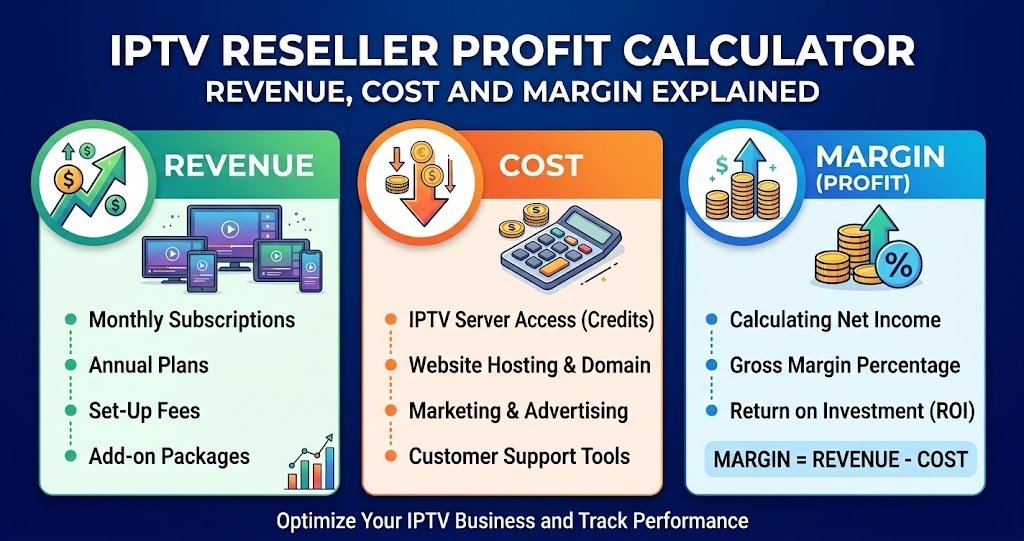
An IPTV Reseller Profit Calculator is really one line of arithmetic: your retail price per customer, minus your cost per credit, multiplied by how many accounts stay active. Everything else is refinement. If you buy credits at roughly £0.73 each on a mid tier package and charge £10 a month, your gross margin per account is about £9.27 before any of your own costs land on top. The number that decides whether the business is worth running is not that gross figure, though. It is what survives after churn, refunds, payment handling and the hours you spend answering messages.
Start With Your Real Cost Per Credit, Not the Package Price
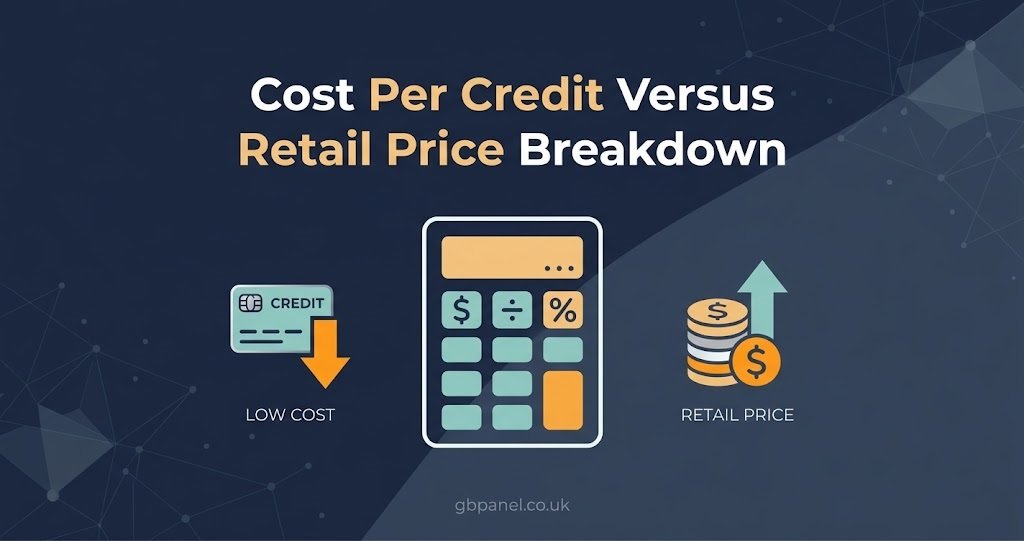
Most resellers quote their spend as a package total, which hides the only figure that matters for pricing. Divide the package cost by the number of credits included and you get the per credit price you should be building everything else around.
Using the tiers currently published on the GB Panel site as a reference point, a starter package sits at around £65 for 50 credits, a growth tier around £110 for 150, and a professional tier around £160 for 300. Those prices are described as approximate and confirmed before purchase, so treat them as a shape rather than a fixed quote. Run the division and the shape is clear: roughly £1.30, £0.73 and £0.53 per credit respectively.
That spread matters more than it first appears. Moving from the smallest tier to the largest roughly halves your input cost without changing a single thing about what you charge. A reseller with 40 active accounts buying in small batches is paying nearly double per account for exactly the same service as a reseller buying in bulk. If you want the fuller breakdown of how tiers are constructed, the guide on how IPTV reseller panel pricing works in the UK covers the structure behind those numbers.
One credit generally equals one month of one customer account, so cost per credit and cost per customer month are usually the same figure. Check that against your own panel terms before you build a pricing sheet on the assumption.
The Three Numbers Every IPTV Reseller Profit Calculator Needs
Strip away the spreadsheet and you are feeding three inputs into the same equation.
Your cost per credit. Covered above. Recalculate it every time you change tier, because your entire margin floor moves with it.
Your average retail price. Not your headline price. Your average, weighted across everyone who is actually paying you. If a third of your customers are on a discounted rate you offered during a quiet month, your average is lower than the number in your head. Add up what genuinely lands in your account in a month and divide by active accounts.
Your retention rate. The percentage of customers who renew when their expiry date arrives. This is the input people skip, and skipping it is why so many IPTV Panel reseller profit projections look healthy on paper and disappointing in practice. A customer paying £10 a month is not worth £120 a year unless they stay a year.
Multiply the first two into a gross margin per account, then apply the third to work out how long that margin actually repeats.
Pro tip: Before you model anything, count how many accounts you renewed last month versus how many came up for renewal. That single ratio is your retention rate, and it is more useful than any industry average you could look up.
Three Worked Examples at Different Scales
The assumptions below are illustrative. Replace them with your own figures and the method still holds.
A small operation, 20 monthly accounts
Buying at starter tier pricing, cost per credit sits near £1.30. Twenty accounts at £10 a month produces £200 in revenue against £26 in credits, leaving £174 gross. That looks excellent until you notice the scale. £174 a month is a side income, and the time you spend on setup messages, device questions and chasing two late payers is real. At this size the calculation is less about profit and more about whether the operation is worth continuing to a point where the bulk tier becomes accessible.
A mid-sized operation, 60 accounts, mixed billing
Say 45 customers pay £10 monthly and 15 pay £85 for a full year. Buying at growth tier pricing of roughly £0.73 per credit, the monthly customers cost you 45 credits, about £32.85, against £450 of revenue. The annual customers cost 12 credits each at the point of activation, roughly £8.76, against £85 received up front. That is £76.24 gross per annual account, banked immediately, with no monthly renewal conversation for a year.
Annual billing changes the shape of the business more than it changes the margin. Slightly less revenue per month per customer, considerably less admin, and a churn problem deferred rather than repeated twelve times.
A larger operation with sub-resellers, 150 accounts
Suppose 110 accounts are your own retail customers at £10 and 40 sit under two sub-resellers you supply at £6. Professional tier pricing of roughly £0.53 per credit gives you a cost base of about £79.50 across 150 credits. Retail side: £1,100. Sub-reseller side: £240. Gross across both: £1,260.
The sub-reseller accounts earn you £5.47 each instead of £9.47, so you are giving away roughly 42% of the margin on that portion of the book. What you buy with it is volume you did not have to acquire or support yourself, since the sub-reseller handles their own customers. Whether that trade is sensible depends entirely on how much of your week currently goes on support rather than growth.
Costs That Sit Outside the Obvious Calculation
Gross margin on credit based reselling looks unusually generous, and that generosity is precisely why so many people underestimate the operating layer underneath it.
| Cost line | Why it gets missed | How to include it |
|---|---|---|
| Non-renewals | The credit is already spent when the customer leaves | Multiply monthly margin by average months retained, not by 12 |
| Refunds and goodwill credits | Treated as one-off exceptions rather than a running cost | Set aside a fixed percentage of monthly revenue as a refund reserve |
| Payment handling | Small per transaction, significant across a hundred accounts | Deduct your processor’s actual percentage and fixed fee from average retail price |
| Support hours | Feels like part of the job, not a cost | Put an hourly value on your time and divide by active accounts |
| Domain, apps and tools | Annual bills sit outside the monthly view | Divide the annual total by twelve and by account count |
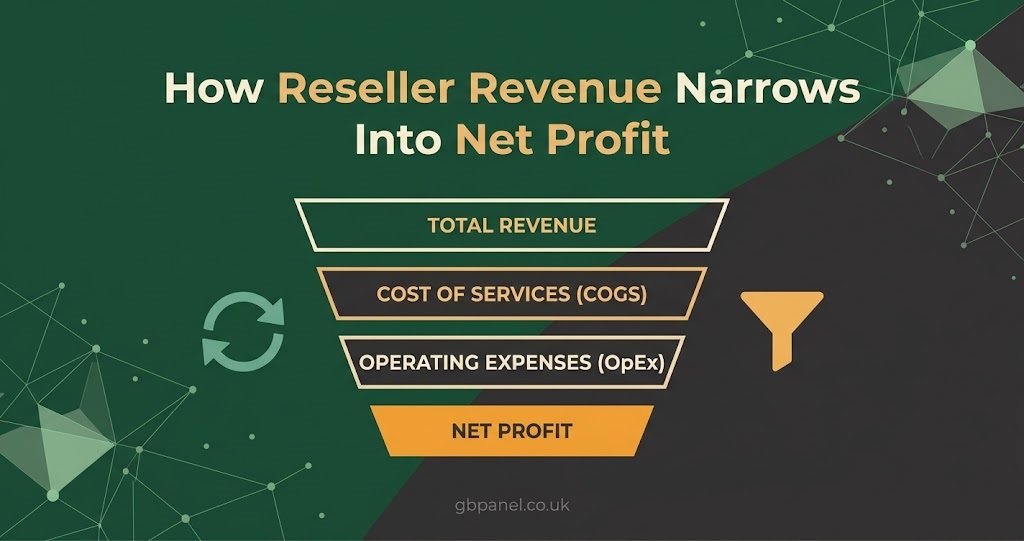
Work through that table honestly and a £9.27 gross margin often lands somewhere closer to £7 net. Still a workable business. Just not the one the first calculation suggested.
Pro tip: Track refunds as a percentage of monthly revenue rather than as individual incidents. Once you can see it as a rate, you can price for it instead of absorbing it.
Retention Is the Multiplier, Not a Footnote
Take the same reseller and change only one variable. At £9.27 net margin per account per month, a customer who stays four months is worth £37.08. The same customer staying ten months is worth £92.70. Nothing about your pricing, your panel, or your credit tier changed. The only difference is whether the person renewed.
This is why a profit model built on monthly revenue alone will mislead you. Two resellers with identical customer counts and identical pricing can have profit figures that differ by a factor of two, and the difference will be invisible in any calculation that stops at gross margin.
The practical consequence: money spent on making renewals easy usually returns more than money spent on discounting to win new customers. Flagging expiring accounts before they lapse, sending a renewal reminder a few days out, and having the account ready to reactivate rather than rebuild all feed directly into the multiplier. The day to day mechanics of running a IPTV reseller panel sit on the same principle.
Using the Number to Make an Actual Decision
A margin figure on its own does nothing. Three decisions it should be driving:
Your pricing floor. Cost per credit plus your per account operating cost plus your refund reserve gives you the point below which a customer is costing you money. Anything you charge under that is customer acquisition, not sales, and should be temporary and deliberate.
When to move up a credit tier. Compare the per credit saving against the capital you need to commit. If dropping from £1.30 to £0.73 saves £0.57 per account and you run 60 accounts, that is £34.20 a month recovered against a larger up front outlay. Work out how many months it takes to repay the difference, and whether your cash position tolerates that gap. Sizing this properly is covered in the piece on how many reseller credits you actually need.
Whether sub-reselling is worth it. Model your book both ways: 100% retail at full margin, versus a split where part of the volume comes at wholesale rates but costs you no support time. If the wholesale portion frees enough hours to grow the retail portion, the lower per account margin pays for itself. If it just shrinks your average, it does not.
Pro tip: Recalculate after any pricing change, then wait two full renewal cycles before judging the result. One month of data on a subscription business tells you almost nothing.
Questions Resellers Ask About Profit Calculations
Does buying a bigger credit package always improve my margin?
It improves your cost per credit, which improves margin only if you actually use the credits. Credits sitting unused on a balance are working capital tied up rather than profit earned. Buy the tier that matches your realistic account volume over the coming few months, not the tier with the best headline per credit rate.
Should I calculate profit per customer or per credit?
Per customer, for pricing decisions. Per credit, for purchasing decisions. They answer different questions and both belong in your working.
How do annual subscriptions affect the calculation?
They pull cash forward and remove eleven renewal decisions from the year, which usually improves realised profit even at a discounted annual rate. The trade is that you have committed the service for twelve months at today’s price, so factor in whether your own credit costs might rise in that window.
What should I set aside for refunds and non-payers?
There is no universal figure to copy, and inventing one would be worse than useless. Track your own for three months, express it as a percentage of revenue, and build that percentage into your pricing floor from then on.
Do I need a spreadsheet, or is mental arithmetic enough?
Under about twenty accounts you can hold it in your head. Past that, a simple sheet with columns for retail price, expiry date, renewal status and payment method will tell you more about your business in one glance than a month of guessing.
Where the Calculation Leaves You
An IPTV Reseller Profit Calculator will not tell you whether to run this business. It will tell you, with reasonable precision, what a single customer is worth to you over their lifetime, and that is the number every other decision hangs off. Cost per credit sets your floor. Average retail price sets your ceiling. Retention decides how many times you collect the difference.
Run your own figures through the method above rather than borrowing someone else’s example numbers. Then check your cost per credit against what your current package actually works out to, because that is the input most UK IPTV Panel resellers get wrong and the easiest one to fix. If your calculation suggests you are overpaying for credits at your current volume, a conversation about the right reseller tier is a sensible next step before you adjust anything on the retail side.
Margin Review Checklist
- Divide your last credit package cost by the credits received to get your true per credit price
- Calculate your weighted average retail price from money actually received, not from your price list
- Count renewals against expiries last month to establish your retention rate
- Multiply monthly net margin by average months retained for a lifetime value per customer
- Deduct payment processing, refunds and tool costs before calling any figure profit
- Set an hourly value on support time and divide it across active accounts
- Compare the per credit saving of the next tier up against the extra capital it requires
- Model sub-reseller volume separately, since it carries a different margin entirely
- Recheck the whole calculation after two full renewal cycles, not after one month
[…] to a recurring monthly charge that stops the moment you miss a payment. Understanding how IPTV panel reseller credits are spent separately from any branding fee helps you compare providers on a like-for-like […]